
K12 Rated Bollards – Elite Crash-Rated Vehicle Barriers
When protecting high-value assets or sensitive sites, you need more than ordinary bollards. Our K12 rated bollards deliver elite level crash-resistance, engineered to stop 15,000 lbs vehicles at 50 mph (≈ 80 km/h) under standard test conditions.
At Secure Bollard, we combine German-engineered design with Indian manufacturing excellence to provide K12 rated bollards that combine strength, certification and site-ready installation.
What Does “K12 Rated” Mean?
“K-ratings” are part of the U.S. Department of Defence vehicle barrier classification system, used in high-security applications. A K12 rating means the barrier was tested to resist a 15,000-lbs vehicle at 50 mph, with minimal penetration.
Equivalent rating in ASTM is M50/P1.
This makes K12 rated bollards suitable for airports, government buildings, data centres, and other critical infrastructure where vehicle-ramming attacks are a threat.
Key Features & Benefits
Certified Impact Resistance: Tested to K12 / M50 standards for high-threat scenarios.
Heavy-Duty Construction: Made from structural steel, premium materials, deep foundations or shallow-mount options as needed.
Minimal Penetration: Designed to limit vehicle penetration to very low levels under test. Reliance Foundry Co. Ltd
Customization & Integration: Optional finishes, architectural covers, lighting, signage, access control integration.
Rapid Response & Deterrence: A visible physical barrier that also serves as a psychological deterrent.
High Assurance for Critical Sites: Ideal for embassies, airports, infrastructure nodes, high-density public venues.
Typical Applications
Airport terminals and aprons
Government buildings & military installations
Data centres and financial institutions
Public plazas, event venues, smart-city gateways
Critical infrastructure (power, transport hubs)
When safety standards demand the highest level of protection, K12 rated bollards become a foundational part of the site security strategy.
Benefits:
- Certified protection
- Anti-terror security
- Long life and reliability
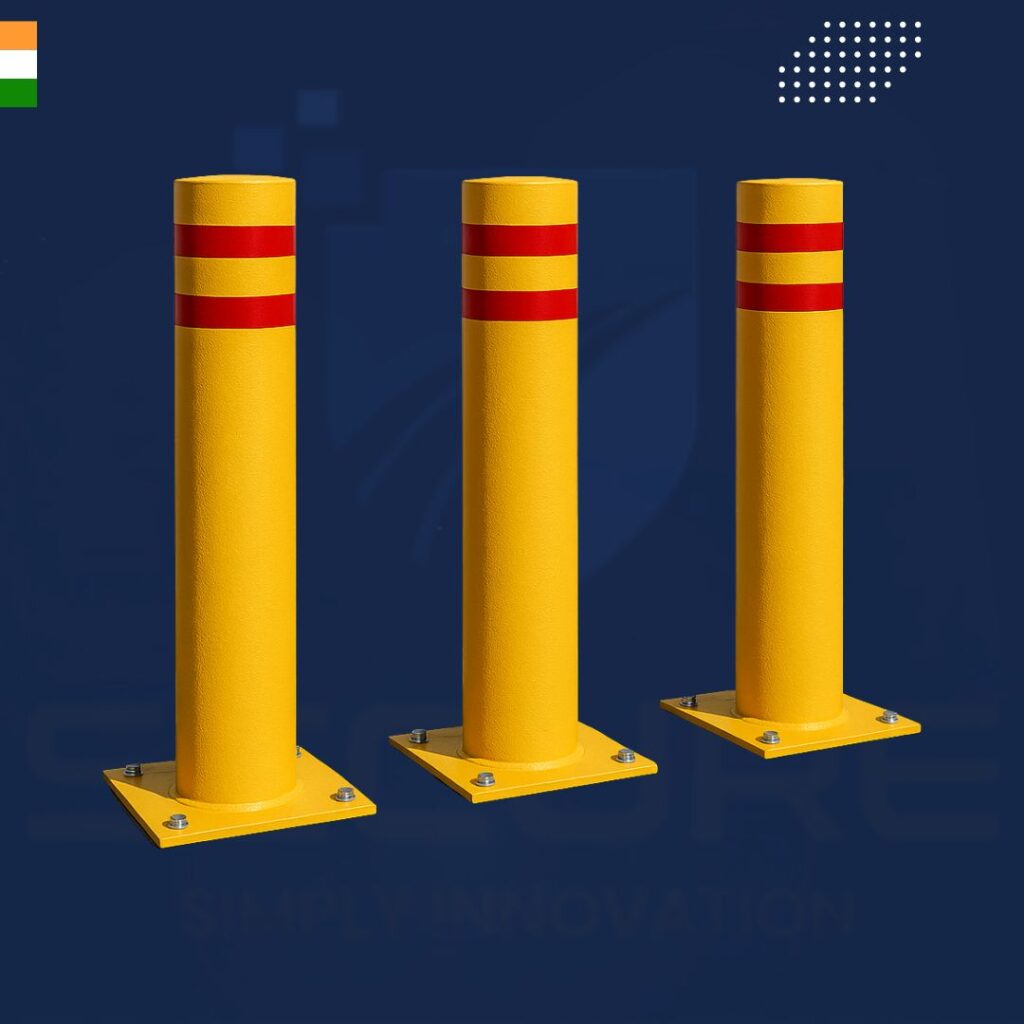
Why Choose Secure Bollard for K12 Rated Bollards?
We specialise in high-end crash-rated solutions, combining proven certification with local manufacturing agility. Our service ensures:
Engineering consultancy from project start
Full documentation and certification support
Custom finishes and integration into access systems
After-sales service and maintenance expertise
For sites where failure is not an option, our K12 rated bollards provide the performance and reliability demanded.
FREQUENTLY
ASKED QUESTIONS
What does a K12 rating mean for bollards?
A K12 rating signifies that the bollard has been crash-tested to stop a 15,000-pound (6.8-ton) vehicle traveling at 50 mph (80 km/h). It is one of the highest crash-resistance levels defined under the U.S. Department of Defence standards, offering superior protection against vehicle-ramming attacks.
What is the difference between K4, K8, and K12 rated bollards?
K4: Stops a 15,000-lb vehicle at 30 mph
K8: Stops a 15,000-lb vehicle at 40 mph
K12: Stops a 15,000-lb vehicle at 50 mph
The higher the rating, the greater the impact-resistance and security level. K12 bollards are used for critical infrastructure and high-threat locations.
Are K12 rated bollards the same as M50 bollards?
Yes. Under modern ASTM F2656 standards, K12 is equivalent to M50 (P1 penetration level). Both indicate the bollard can stop a heavy vehicle at 50 mph with minimal penetration.
Where are K12 rated bollards used?
K12 rated bollards are commonly installed at:
Airports and seaports
Embassies and government buildings
Military bases
Data centres and power plants
High-profile public spaces and event arenas
They are ideal anywhere high-speed vehicle intrusion or terrorist ramming attacks are a risk.
What materials are used in K12 bollards?
Secure Bollard manufactures K12 bollards using high-strength structural steel with options for powder coating, stainless-steel finish, or architectural sleeves for aesthetic appeal. Each unit is engineered for corrosion resistance and long-term outdoor performance.
Can K12 bollards be customized or integrated with access control systems?
Absolutely. We offer custom sizes, finishes, and integration with:
RFID / card readers
Hydraulic or electro-mechanical lifting mechanisms
LED lighting
Smart access systems and sensors
This allows seamless integration into modern smart-city and security infrastructures.
What is the difference between fixed, removable, and automatic K12 bollards?
Fixed K12 bollards: Permanently installed; ideal for perimeter protection.
Removable K12 bollards: Can be detached for temporary access.
Automatic K12 bollards: Hydraulic or electro-mechanical rising models for controlled entry and exit.
How are K12 rated bollards installed?
Installation involves deep or shallow foundations, depending on the site’s surface and subsoil. Secure Bollard provides end-to-end installation support, ensuring the bollards meet certified performance levels once deployed.
Are K12 rated bollards tested and certified?
Yes. All Secure Bollard K12 models are tested to international crash-rating standards (DoS K12 / ASTM M50) and comply with recognized vehicle impact testing procedures. Certification documents are available upon request.
How much do K12 rated bollards cost?
The cost depends on size, finish, and automation type (manual, hydraulic, or electro-mechanical). Typical pricing starts around ₹4.5 lakh per unit, including installation consultation. For bulk or custom requirements, contact us for a detailed quote.
Why choose Secure Bollard for K12 crash-rated bollards?
Secure Bollard combines German-engineered technology with Indian manufacturing expertise. We provide:
Certified crash-rated solutions
Expert design and installation support
Integration with lighting and access control
Made-in-India quality with global reliability
How can I get a quotation or technical brochure?
You can reach our team directly at 📧 info@securebollard.com or 📞 +91-76004 23206 for a detailed specification sheet, quote, and installation guidance.
We Secure: Airports, Defense Bases, Borders, Utilities, Financial Institutions, Data Centers, Hotels, Toll Plazas, and Critical Government & Private Buildings.
